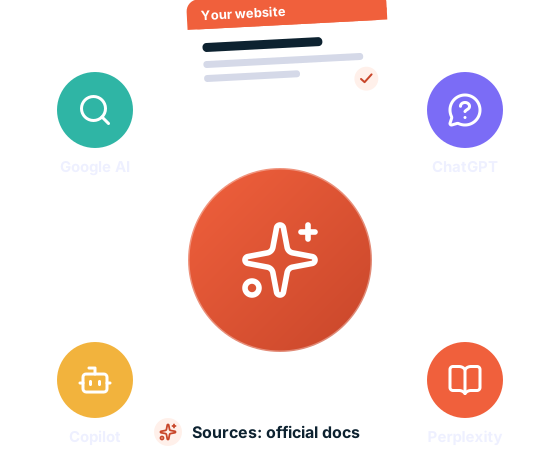
- AI SEO (also called GEO, AEO or LLM SEO) means making your business easy for AI tools to find, trust and cite. Google says that for its AI Overviews and AI Mode this is still SEO: there are no extra requirements.
- To be cited, your pages must first be crawlable and indexed. That means allowing the right crawlers (Googlebot, Bingbot, OAI-SearchBot, PerplexityBot, Claude-SearchBot) and not blocking them by accident in your firewall.
- What helps most is original, useful content you're genuinely expert in, clear pages that answer questions directly, and an honest reputation across the web. None of the AI companies publish a shortcut.
- You can now measure some of it for free: Google Search Console has a Generative AI performance report and Bing Webmaster Tools has an AI Performance report.
- Nobody can guarantee you'll be recommended by ChatGPT or shown in AI Overviews. Treat any agency that promises it, or sells llms.txt as a magic fix, with caution.
What does an AI SEO agency do?
An AI SEO agency works on your website and your wider online presence so that AI tools, such as Google's AI Overviews and AI Mode, ChatGPT search, Microsoft Copilot, Perplexity and Claude, can find your pages, understand what you do and cite or recommend you when people ask questions you can answer. In practice it's search engine optimisation (SEO) with extra attention on how AI answers are put together and how to measure them.
Check access
Make sure search engines and AI crawlers can actually reach and read your pages, including through your hosting, CDN and firewall.
Audit what AI says
Ask AI tools the questions your customers ask and record whether you're mentioned, cited, and described accurately.
Improve key pages
Rewrite service, product and advice pages so they answer real questions directly, with facts, prices, examples and evidence.
Strengthen trust
Keep your business details consistent everywhere, encourage genuine reviews and earn honest mentions in places your customers read.
Measure
Track AI impressions and citations in Google Search Console and Bing Webmaster Tools, plus enquiries and AI referral visits.
Keep it current
Update pages when facts, prices or the AI tools themselves change, and report every change to you in plain English.
Google lists "optimizing for generative AI" among the useful services an SEO can offer, alongside site reviews, technical advice, content development and keyword research (Google: Do you need an SEO?). So an AI SEO agency is best thought of as an SEO agency that takes AI answers seriously, not a different kind of business.
AI visibility readiness checker: how ready is your website?
This free AI visibility readiness checker scores how ready your website is to be found and cited by AI tools, out of 100, from 18 yes/partly/no questions. For example, a business that has sorted crawler access and its business listings but nothing else scores 60 out of 100 (Partly ready). Answer the questions to get your score and your top fixes.
Access (35 points)
Facts about you (25 points)
Content (25 points)
Reputation and checking (15 points)
| Situation | Score | Result | Try it |
|---|---|---|---|
| Nothing done yet | 0 out of 100 | Not ready yet | Load |
| Crawler access sorted, nothing else | 35 out of 100 | Not ready yet | Load |
| Access and business listings done | 60 out of 100 | Partly ready | Load |
| Everything partly done | 50 out of 100 | Partly ready | Load |
| All done except reputation and checking | 85 out of 100 | Mostly ready | Load |
| Everything done except the firewall check | 92 out of 100 | Partly ready | Load |
| All 18 checks done | 100 out of 100 | Ready | Load |
How the score is calculated
- Each of the 18 checks has points (below), adding up to 100.
- Yes scores the full points, Partly scores half, No (or no answer) scores nothing.
- The total is rounded to the nearest whole number (halves round up).
- Result: 90 or more = Ready, 70 or more = Mostly ready, 40 or more = Partly ready, below 40 = Not ready yet.
- If either of the first two crawler-access checks isn't a full Yes, the result can't be better than Partly ready, because AI tools can't use pages they can't reach.
- Your top fixes are the checks you haven't fully done, biggest points first.
The points are our own judgement of what matters most, based on the official guidance linked below. No AI company publishes a readiness score, and a high score doesn't guarantee you'll be cited. Nothing you enter is sent anywhere: the checker runs in your browser.
| Check | Points | Why it matters |
|---|---|---|
| 1. Does your robots.txt allow Googlebot, Bingbot, OAI-SearchBot, PerplexityBot and Claude-SearchBot? | 10 | Fix robots.txt so the search crawlers are allowed; without access nothing else counts. (source) |
| 2. Have you checked your firewall, CDN or "bot protection" isn't blocking those crawlers? | 8 | Check your hosting/CDN bot settings; Google lists crawl access through CDNs as a basic. (source) |
| 3. Is your site verified in Google Search Console with a sitemap submitted? | 7 | Set up Google Search Console and submit your sitemap. (source) |
| 4. Is your site set up in Bing Webmaster Tools with a sitemap? | 5 | Add your site to Bing Webmaster Tools; its AI Performance report covers Copilot. (source) |
| 5. Do your important pages show as indexed in Search Console? | 5 | Fix pages that aren't indexed: only indexed pages can be AI Overview links. (source) |
| 6. Is your Google Business Profile complete and accurate? | 8 | Complete your Google Business Profile (hours, services, area, photos). (source) |
| 7. Have you claimed Bing Places for Business? | 4 | Claim Bing Places for Business with the same details as Google. (source) |
| 8. Are your business name, address, phone and description the same everywhere online? | 7 | Make your business details identical on your site, listings and directories. (our view) |
| 9. Does your site have a clear About page (who, where, how long, provable credentials)? | 6 | Write a clear About page with facts you can prove. (our view) |
| 10. Do your main pages answer your customers' common questions directly, near the top? | 8 | Rewrite key pages to answer real customer questions first, then give detail. (source) |
| 11. Are prices or price guides, areas covered and key facts written as text (not only images or PDFs)? | 6 | Put prices, areas and key facts in plain text on the page. (source) |
| 12. Do your pages show first-hand expertise: real examples, case studies, your own data? | 6 | Add real examples and what you know that others don't (non-commodity content). (source) |
| 13. Does any structured data on your site match what visitors see? | 3 | Add or fix Organization/LocalBusiness markup so it matches the page. (source) |
| 14. Are your key pages dated and kept up to date? | 2 | Show last-updated dates and fix anything out of date. (source) |
| 15. Do you ask every happy customer for a genuine review? | 6 | Ask every happy customer for an honest review (never buy or write them). (source) |
| 16. Are you mentioned on independent sites your customers use (trade bodies, local press, directories)? | 4 | Get listed and mentioned where your customers already look. (source) |
| 17. Do you ask AI tools your customers' questions at least monthly and note the answers? | 3 | Start a monthly AI visibility log of customer questions in each tool. (our view) |
| 18. Do you check the AI reports in Search Console and Bing Webmaster Tools? | 2 | Check Google's Generative AI performance report and Bing's AI Performance report. (source) |
Share or save your answers: the link under your result reproduces it. Format: ?answers= followed by 18 letters (y = Yes, p = Partly, n = No) in question order, for example https://ukaiseoagency.co.uk/?answers=yyyyyyyyynnnnnnnnn scores 60 (Partly ready).
Is AI SEO different from traditional SEO?
Mostly the same foundations, with a different finish line. Google states that its AI features are rooted in its core Search ranking and quality systems, and that optimising for them "is optimizing for the search experience, and thus still SEO". What changes is the goal: instead of only ranking a link, you want your facts to be picked up, quoted and credited inside an answer, across several AI tools that each have their own crawler and index.
What stays the same
- Pages must be crawlable, indexable and fast to load on a phone
- Helpful, original, people-first content wins over keyword-stuffed pages
- Clear headings, internal links and important content in text (not only images)
- Structured data must match what's visible on the page
- Spam policies apply: no bought links, no mass-produced pages
- Your Google Business Profile and other listings must be accurate
What's different
- Several "search engines" matter now: Google, Bing (and Microsoft Copilot), ChatGPT search, Perplexity and Claude each have their own crawlers
- AI tools break a question into many related searches (Google calls it "query fan-out"), so a page can be cited for questions it never targeted
- The prize is a citation or a mention inside an answer, not only a position in a list of links
- Answers are personalised and change between runs, so "rankings" are less stable and harder to report
- What others say about you (reviews, articles, forum discussions) can be summarised straight into an answer
- New measurement: Google's Generative AI performance report and Bing's AI Performance report
Source for Google's position: Optimizing your website for generative AI features on Google Search.
GEO, AEO, LLM SEO: what do the names mean?
| Name | What it means |
|---|---|
| AI SEO | The most common plain-English name: SEO aimed at AI search as well as classic results. |
| GEO (generative engine optimisation) | Named in a 2023 academic paper (Aggarwal et al.) that tested ways to make content more visible in AI-generated answers. Its results come from a test set-up, not from inside any live product. |
| AEO (answer engine optimisation) | Older term from the featured-snippet and voice-assistant era, now used for AI answers too. |
| LLM SEO / LLMO | Optimising for large language models (LLMs) such as those behind ChatGPT, Gemini and Claude. |
| ChatGPT SEO | Aiming to be found and cited in ChatGPT search. In practice: the same work, plus making sure OpenAI's OAI-SearchBot can reach your site. |
| AI Overviews optimisation | Aiming at Google's AI Overviews and AI Mode. Google says these need no special optimisation beyond SEO best practice. |
| AI search optimisation / AI visibility | Umbrella terms for the same work, often used by UK agencies and tools. |
Generative engine optimisation (GEO) and AI search optimisation are the terms you'll see most in UK agency proposals. Ask what work sits behind the label.
How do AI tools choose which websites to cite?
AI search tools retrieve web pages from their own search index (or a partner's), then write an answer "grounded" in those pages and link to some of them. Each company publishes which crawler feeds its search and how to allow or block it. None of them publish exactly how they choose between eligible pages, so anyone who claims to know the full formula is guessing. Here's what is documented.
- CrawlThe tool's crawler fetches your page (if robots.txt and your firewall allow it).
- IndexThe page is stored in a search index: Google's, Bing's or the AI company's own.
- Fan outYour question is rewritten into several related searches.
- RetrieveRelevant pages are pulled back by the search systems.
- GroundThe AI model writes an answer based on those pages.
- CiteSome of the pages used are shown as links or sources.
Simplified picture of retrieval-based AI search, based on Google's and the AI companies' own descriptions. Each product differs in detail.
Google AI Overviews and AI Mode
Google says these features use its core Search ranking systems to retrieve pages from its Search index ("retrieval-augmented generation", also called grounding) and may run a "query fan-out" of related searches. To be shown as a supporting link a page must be indexed and eligible to show with a snippet. Since 31 August 2026 every site also has a Search generative AI setting in Search Console; including your site is the default.
Controls: Googlebot (robots.txt), snippet controls (nosnippet, max-snippet), Search Console's Search generative AI control. Google-Extended covers Gemini training and Gemini app grounding, not Search.
Sources: AI features and your website, Optimizing your website for generative AI features on Google Search, Search generative AI control, Google common crawlers (Google-Extended)
ChatGPT search (OpenAI)
OpenAI says OAI-SearchBot is used to surface websites in ChatGPT's search features, and that sites which opt out of OAI-SearchBot won't be shown in ChatGPT search answers (though they can still appear as navigational links). ChatGPT search sometimes partners with other search providers, and its help page names Microsoft among them. ChatGPT-User visits pages when a user asks; GPTBot collects content for AI model training.
Controls: OAI-SearchBot (search), GPTBot (training), ChatGPT-User (user-initiated visits, robots.txt may not apply).
Sources: Overview of OpenAI crawlers, Searching the web with ChatGPT
Microsoft Copilot and Bing
Bing's AI Performance report (public preview since February 2026) shows how often a site is cited in Microsoft Copilot, AI-generated summaries in Bing and select partner integrations. Microsoft recommends IndexNow so AI systems see the latest version of a page, and Bing Places for Business for local details.
Controls: Bingbot (robots.txt), IndexNow, Bing Webmaster Tools, Bing Places for Business.
Sources: Introducing AI Performance in Bing Webmaster Tools Public Preview (10 Feb 2026)
Perplexity
Perplexity says PerplexityBot surfaces and links websites in its search results and isn't used to crawl content for AI foundation models. Perplexity-User fetches pages when a user asks a question and generally ignores robots.txt because a person requested it. Perplexity also documents how to let its bots through firewalls such as Cloudflare's.
Controls: PerplexityBot (search), Perplexity-User (user-initiated visits).
Sources: Perplexity crawlers
Claude (Anthropic)
Anthropic says Claude-SearchBot indexes content to improve search results, Claude-User fetches pages when people ask Claude questions, and ClaudeBot collects content that may be used for training. Blocking Claude-SearchBot or Claude-User may reduce your visibility in Claude's search answers.
Controls: Claude-SearchBot (search), Claude-User (user-initiated), ClaudeBot (training).
Sources: Does Anthropic crawl data from the web, and how can site owners block the crawler?
What isn't published
No AI company publishes:
- How each tool weighs one eligible page against another (none of them publish this)
- How much reviews, brand mentions or social media count in a particular answer
- Whether a specific schema type, page length or writing style makes you more likely to be cited (Google says there's no special schema or ideal page length for its AI features)
- Why the same question gives different sources on different days, devices or accounts
Anything beyond the official documentation is opinion or experiment. Good agencies say which is which; Google's guidance on third-party advice says the same.
The good news is that what Google does say is consistent and practical: make content that is "unique, valuable" and "non-commodity", keep the technical basics right, and don't chase hacks (Google). Bing gives similar advice for being cited: clear structure, depth and expertise, evidence and cited sources, and fresh content (Bing Webmaster Blog).
Which AI crawlers should your robots.txt allow?
If you want to appear in AI answers, allow the search crawlers: Googlebot, Bingbot, OAI-SearchBot, PerplexityBot and Claude-SearchBot, plus the user-triggered agents ChatGPT-User, Perplexity-User and Claude-User. Whether you also allow GPTBot and ClaudeBot (AI training) is a separate business decision; their owners say blocking them is about training, not search. Google-Extended is different: it covers Gemini training and grounding in the Gemini app, but not Google Search.
| User agent | Company | What it does | If you block it |
|---|---|---|---|
Googlebot | Crawls for Google Search, including AI Overviews and AI Mode | You disappear from Google Search, not just its AI features | |
Google-Extended | A robots.txt token covering training of Gemini models and grounding in Gemini Apps and Vertex AI (not Google Search) | Google says it doesn't affect Google Search inclusion or ranking; it may limit use in Gemini answers | |
Bingbot | Microsoft | Crawls for Bing search; Bing's AI Performance report covers citations in Copilot and Bing's AI summaries | You drop out of Bing, and its AI answers |
OAI-SearchBot | OpenAI | Surfaces websites in ChatGPT search | Not shown in ChatGPT search answers (navigational links may still appear) |
ChatGPT-User | OpenAI | Visits a page when a ChatGPT user asks | OpenAI says robots.txt may not apply to these user-initiated visits |
GPTBot | OpenAI | Collects content that may be used to train OpenAI's models | Content shouldn't be used for training; separate from search |
PerplexityBot | Perplexity | Surfaces and links sites in Perplexity search; not used for model training | Less likely to be linked in Perplexity answers |
Perplexity-User | Perplexity | Fetches a page when a Perplexity user asks | Perplexity says it generally ignores robots.txt for user requests |
Claude-SearchBot | Anthropic | Indexes content to improve Claude's search results | Anthropic says it may reduce your visibility in Claude's search |
Claude-User | Anthropic | Fetches pages when a Claude user asks | Claude can't fetch your page for that user |
ClaudeBot | Anthropic | Collects content that may be used for training | Future content excluded from training datasets |
A simple robots.txt that welcomes AI search
# Welcome search engines and AI assistants
User-agent: *
Allow: /

User-agent: OAI-SearchBot
Allow: /

User-agent: PerplexityBot
Allow: /

User-agent: Claude-SearchBot
Allow: /

Sitemap: https://www.example.co.uk/sitemap.xml
Rules for * already cover every crawler; naming the AI search crawlers just makes your intention obvious. Then check the bit most people miss: your hosting, CDN or firewall. Google lists "ensuring that crawling is allowed in robots.txt, and by any CDN or hosting infrastructure" as an SEO basic for its AI features, and Perplexity publishes instructions for letting its bots through Cloudflare and AWS firewalls.
Does llms.txt help you appear in AI answers?
- llms.txt is a proposal, not a standard: a plain Markdown file at
/llms.txtthat summarises a site and links to its key pages for AI tools. It was first written in 2024 and is maintained at llmstxt.org. - Google says Google Search doesn't use llms.txt, and that creating one "will neither harm nor help" your visibility in Google Search, including its AI features.
- Some AI companies publish llms.txt files for their own developer documentation (OpenAI's crawler documentation links to one), and some tools read them. No AI search company we checked documents using llms.txt to choose which sites to cite.
- Our view: it takes minutes to add and does no harm (this site has one), but don't pay an agency for it as an AI ranking fix.
Sources: llmstxt.org, Google AI optimisation guide, OpenAI crawler documentation.
What do AI SEO services include?
A good AI SEO service covers three areas: technical access (can AI tools reach and read you?), content (is there something worth citing?) and reputation off your site (do others confirm what you say?). Plus honest measurement. Below is what each usually includes, with what the official guidance says about it.
Technical
- Crawler access: robots.txt allows the search crawlers; your CDN, firewall or "bot protection" doesn't silently block them. Google lists this first.
- Indexing: Google Search Console and Bing Webmaster Tools set up, sitemaps with accurate dates, IndexNow for Bing. Check the Search generative AI setting is on "include".
- Structured data: Organization, LocalBusiness, Product, FAQ or Article markup that matches the visible page. Useful for rich results; Google says it isn't required for AI features.
- Page experience and speed: Works well on phones, loads quickly, main content easy to tell apart from ads and menus.
- Text, not just pictures: Prices, opening hours, service areas and key facts written in HTML text, not locked in images, PDFs or scripts.
- llms.txt (optional): A short Markdown summary for tools that read it. Cheap; don't expect ranking gains.
Content
- Answer-first pages: Each page opens with a direct answer, then the detail. Clear question headings and short sections help people and machines.
- Non-commodity content: First-hand experience, your own prices and processes, real examples. Google contrasts this with "commodity content" that restates common knowledge.
- Original data and tools: Your own figures, surveys, calculators or checklists, with the results in plain text so they can be quoted.
- Evidence and citations: Link to official sources for any claim. Bing recommends supporting claims with examples, data and cited sources.
- Entities and consistency: The same business name, address, phone, services and description on your site, Google Business Profile, Bing Places and directories.
- Freshness: Dates shown and kept current; old facts fixed. Not hundreds of near-identical pages for every question wording (Google's scaled content abuse policy).
Off-site reputation
- Genuine reviews: Ask real customers on Google and relevant review sites. Fake or incentivised reviews are against UK consumer law (see the CMA's guidance) and platform rules.
- Earned mentions and digital PR: Useful stories, data or comment that journalists, trade bodies and bloggers choose to cover. Paid placements must be labelled and their links marked sponsored.
- Listings: Accurate Google Business Profile, Bing Places, trade and local directories that people actually use.
- Communities: Helpful, honest participation where your customers ask questions. Google says seeking inauthentic "mentions" isn't as helpful as it might seem.
Measurement
- AI impressions and citations: Search Console's Generative AI performance report and Bing's AI Performance report.
- Prompt checks: A fixed list of customer questions asked in each AI tool on a schedule, logged with dates.
- Business results: Enquiries, calls and sales, and visits referred from AI tools in your analytics.
Sources: Google AI features and your website, Google AI optimisation guide, Google spam policies, Bing AI Performance announcement, CMA fake reviews guidance.
How do you measure AI visibility?
Use the free first-party reports first: Google Search Console's Generative AI performance report (impressions in AI Overviews and AI Mode) and Bing Webmaster Tools' AI Performance report (citations in Copilot and Bing's AI answers). Add a monthly manual check of the questions your customers ask, and watch enquiries. Paid "AI visibility" tools can help, but every method has blind spots.
| Method | What it shows | Limits |
|---|---|---|
| Google Search Console: Generative AI performance report source | How many times links to your site were shown in AI Overviews and AI Mode, by page, country, device and date. Rolled out to all sites on 31 August 2026. | Impressions only; Google only; the report doesn't appear until a site has enough AI impressions. |
| Google Search Console: Performance report (Web) source | AI Overviews and AI Mode traffic is also included in your overall search clicks and impressions. | Mixed in with ordinary results. |
| Bing Webmaster Tools: AI Performance (public preview) source | Total citations, average cited pages, a sample of "grounding queries" and page-level citations across Copilot, Bing AI summaries and select partners. | Microsoft surfaces only; still a preview; grounding queries are a sample. |
| Your analytics | Visits referred from AI tools' websites (for example chatgpt.com, perplexity.ai, copilot.microsoft.com, claude.ai) and what those visitors do next. | Shows clicks, not mentions; some visits arrive without a referrer. |
| Third-party prompt-tracking tools source | Run a set list of prompts through AI tools repeatedly and record when you're mentioned or cited, often against competitors. | Answers vary by person, location, memory and wording. Google warns that no third-party tool has access to its internal ranking or AI systems. |
| Manual checks | Ask 10 to 20 real customer questions in each tool each month, logged-out where possible, and note: mentioned? cited? accurate? | Small sample; personalised results; takes time. |
| Ask your customers | Add "How did you hear about us?" to your enquiry form and phone script, with "ChatGPT or another AI tool" as an option. | Relies on memory. |
A simple monthly AI visibility log: a spreadsheet with one row per question per tool, and columns for date, tool, question, were we mentioned, were we linked, was it accurate, and which sources were cited. After three months you'll see real trends, and you'll know which source pages to fix when an answer is wrong.
How much does an AI SEO agency cost?
AI SEO is usually sold in the same ways as SEO: a one-off audit, a monthly retainer or a fixed-price project. We looked for published, independent UK price ranges for AI SEO and didn't find any we'd stand behind (most figures online are agencies' own marketing), so we don't quote a range here. Instead, here's what drives the price and how to compare quotes.
| Model | What you get | How it's priced | Best for |
|---|---|---|---|
| One-off audit | A review of crawler access, indexing, key pages, listings and how AI tools currently describe you, with a prioritised list of fixes. | Fixed fee, set by site size and depth | Finding out where you stand before committing |
| Monthly retainer | Ongoing fixes, content, reputation work and monthly reporting. | Fixed monthly fee, often with a minimum term | Competitive markets where work needs to be steady |
| Project | A defined piece of work: a site rebuild, a new section of advice pages, a data study or a calculator. | Fixed price for the agreed scope | A clear one-off need |
| Consultancy or training | Advice and training for your own team, who then do the work. | Hourly or day rate | Businesses with in-house staff |
What drives the price
Size and state of your site
A ten-page local site is a different job from an e-commerce site with thousands of products or a site with technical problems.
How competitive your market is
National, crowded markets need more content and reputation work than a niche local trade.
How much content is needed
Writing and checking expert pages, data studies and tools takes the most time.
Off-site work
Digital PR and review programmes add cost; they depend on people, not software.
Tools and reporting
Paid prompt-tracking tools add a monthly cost that some agencies pass on.
Who does the work
Senior specialists cost more than junior staff; ask who will actually work on your account.
What to get in writing before you sign
- Exactly what's included each month, in hours or deliverables
- Which reports you'll get and which official tools they come from
- Minimum term, notice period and what happens to your content and accounts if you leave
- Whether tool subscriptions, content writing and PR are included or extra
- Prices with and without VAT
Ask two or three agencies to quote for the same written brief, so you can compare like with like. Our free AI visibility check gives you a starting brief.
How long does AI SEO take to work?
Technical fixes can be picked up within days: OpenAI says changes to robots.txt take about 24 hours to reach ChatGPT search, and Perplexity says up to 24 hours. Google says recrawling can take from several days to several months. Content and reputation work builds over months, and nobody can promise a date, because inclusion in any search or AI answer isn't guaranteed.
The usual sequence of AI SEO work
- AuditCheck access, indexing, listings and what AI tools currently say about you. Set a baseline.
- Fix accessUnblock crawlers, fix indexing problems, set up Search Console and Bing Webmaster Tools.
- ImproveRewrite the pages that matter most so they answer questions directly with real facts.
- Build trustConsistent listings, genuine reviews, earned mentions.
- MeasureCompare AI impressions, citations, prompt checks and enquiries with the baseline.
- RefineKeep content current and repeat what's working.
| What | How long | Source |
|---|---|---|
| robots.txt change reaches ChatGPT search | About 24 hours | OpenAI |
| robots.txt change reaches Perplexity | Up to 24 hours | Perplexity |
| Google recrawls and processes a change | Several days to several months, depending on the page | Google Search Central |
| Search Console Generative AI report shows data | Only once your site has enough AI impressions | Search Console Help |
| Content and reputation work | Usually months, with no guaranteed date | Our view, not an official figure |
Be sceptical of fixed promises like "cited by ChatGPT in 30 days". The honest answer is a plan, a baseline and regular measurement.
What are the red flags when hiring an AI SEO agency?
Walk away from anyone who guarantees you'll be recommended by ChatGPT or appear in AI Overviews, won't explain what they'll change, or offers links, reviews or "mentions" for money. Google's own advice on hiring an SEO says no one can guarantee a #1 ranking, and its spam policies now explicitly cover attempts to manipulate AI responses.
- Promises of a top spot or a guaranteed AI recommendationGoogle: "No one can guarantee a #1 ranking on Google." No AI company publishes a way to buy or guarantee a place in its unpaid answers. Ads are separate and labelled. (source)
- "Secret" or "proprietary" methods they won't explainGoogle advises caution if a company is secretive or won't clearly explain what it intends to do. You're responsible for what they do to your site. (source)
- Claims of a special relationship, partnership or "approved" toolGoogle says it doesn't evaluate or endorse third-party SEO tools and no third-party tool has access to its internal ranking or AI systems. (source)
- Buying links or link "packages"Buying or selling links for ranking purposes is link spam under Google's spam policies. (source)
- Fake reviews, paid "mentions" or planted forum postsGoogle says inauthentic mentions aren't as helpful as they might seem. Fake reviews break UK consumer protection law. (source)
- Hundreds of AI-written pages for every question variationGoogle names creating content for every fan-out query primarily to manipulate AI responses as a breach of its scaled content abuse policy. (source)
- llms.txt, "AI schema" or "chunking" sold as the main fixGoogle says Search ignores llms.txt, there's no special schema for its AI features and you don't need to chunk content. (source)
- Reports built only on their own "AI visibility score"Ask for first-party data too: Search Console, Bing Webmaster Tools and your enquiries. (source)
- Asking for full control of Search Console at the audit stageGoogle suggests granting read access only for an audit. (source)
- Cold emails saying "you're invisible in ChatGPT"Google advises being wary of SEO firms that email you out of the blue. (source)
- Long lock-in before they've audited anythingA good agency can explain what it will do in the first month before asking for a long contract.
Google also reminds site owners that "you are responsible for the actions of any companies you hire" (Google). If an agency breaks the spam policies on your behalf, it's your site that suffers.
What should you ask an AI SEO agency before you sign?
Ask how they'll measure success, exactly what they'll change, whether they buy links or reviews, and who owns the work if you leave. Their answers should be specific, reference official guidance and admit what can't be promised.
- Which official guidance do you follow?Listen for Google's AI optimisation guide, Bing's webmaster guidance and the AI companies' crawler documentation. Google suggests asking whether an SEO cites official documentation.
- What will you change in the first month, and will you tell me about every change?You want a specific list, not "we'll optimise your site".
- How will you measure success?Expect named reports (Search Console, Bing Webmaster Tools), prompt checks with dates, and enquiries, not just a score from their own tool.
- What results do you expect, in what timeframe, and what could stop that?A straight answer includes the risks.
- Can I see examples of your work and speak to a past client?Google's hiring advice suggests asking for examples and checking references.
- Do you buy links, reviews or mentions?The answer should be a clear no.
- Do you use AI to write content? Who checks it?AI-assisted content is fine if it's accurate and useful; ask who is accountable for the facts.
- Who owns the content, accounts and data if we stop working together?It should be you.
- What's the minimum term and notice period?Get it in writing before you start.
- What experience do you have in my industry and area?Local, national and e-commerce work need different skills.
- What do you need from us?Time for interviews, access, approvals, real examples and data.
- What won't you do?A good agency will say what's out of scope and what it doesn't recommend.
Do you need an AI SEO agency, or can you do it yourself?
Many small local businesses can do the basics themselves; Google says as much in its own advice on hiring an SEO. An agency earns its fee when your site is large or has technical problems, your market is competitive, you're rebuilding the site, or you simply don't have the time.
| Your situation | What usually makes sense |
|---|---|
| Small local business, a simple site and a few hours a month | Start with the DIY checklist below, Google's SEO starter guide and your Google Business Profile. Get a one-off audit if you're stuck. |
| You already pay an SEO agency | Ask them how they handle AI features. Google says optimising for its AI search is still SEO, so it should already be part of the work. |
| Rebuilding or moving your website | Get specialist help early. Google says the best time to hire is before a redesign or launch. |
| Larger site, e-commerce or technical problems | An audit plus project or retainer work is usually worth it. |
| Competitive national market | Expect ongoing content and reputation work; a monthly retainer is the usual model. |
AI SEO checklist for small businesses
Yes, a small business can cover most of the basics without an agency. Work through this checklist: it starts with making sure AI tools can reach you, then fixes the facts they'll repeat about you, then builds content and reputation.
Access
- Check robots.txtOpen yourdomain.co.uk/robots.txt. Make sure it doesn't block Googlebot, Bingbot, OAI-SearchBot, PerplexityBot or Claude-SearchBot.
- Check your firewall or CDNIf you use Cloudflare or similar "bot protection", check it isn't blocking AI search crawlers.
- Set up Google Search ConsoleVerify your site, submit your sitemap and check the Search generative AI setting is on "include".
- Set up Bing Webmaster ToolsSubmit your sitemap; Bing's AI Performance report covers Copilot citations. Turn on IndexNow if your website platform offers it.
Facts about you
- Claim your Google Business ProfileName, address, phone, hours, services and photos, all accurate.
- Claim Bing Places for BusinessSame details as Google. Microsoft recommends it for local AI answers.
- Make your details consistentBusiness name, address, phone and a one-sentence description the same everywhere, including directories.
- Write a clear About pageWho you are, where you work, how long you've traded, qualifications and memberships you can prove.
Content
- List your customers' questionsWrite down the 20 questions you hear most on the phone and by email.
- Answer them directlyGive each important question a clear answer near the top of a relevant page, then the detail.
- Put real facts in textPrices or price guides, areas covered, timescales, guarantees and process, written as text not images.
- Show your expertiseReal examples, photos of your work, case studies and what you've learned that others haven't.
- Add basic structured dataOrganization or LocalBusiness markup that matches what's on the page. Many website platforms do this for you.
- Date and update your pagesShow when key pages were last updated, and fix anything out of date.
Reputation and checking
- Ask every happy customer for a reviewGenuine reviews only; never buy or write them.
- Get listed where your customers lookTrade bodies, local chambers, industry directories and supplier pages.
- Ask AI tools about yourself each month"Who's a good [your trade] in [your town]?" and "What does [your business] do?" Note what's wrong and fix the source.
- Check your reportsSearch Console's Generative AI performance report and Bing's AI Performance report, once you have data.
Total: 18 checks. If you can tick them all, you're ahead of most small businesses, and you'll be a much better-informed buyer if you do hire an agency.
AI SEO glossary
The terms you'll meet in AI SEO proposals and reports, in plain English.
- AI Overviews
- AI-generated summaries at the top of some Google results, with links to supporting pages. Google says they only appear when they add something to classic results.
- AI Mode
- Google's conversational AI search for longer, more complex questions and follow-ups, with links to supporting sites.
- AI SEO
- Search engine optimisation that also aims for visibility in AI-generated answers.
- GEO
- Generative engine optimisation: improving how often your content is used and cited in AI-generated answers.
- AEO
- Answer engine optimisation: making content easy for answer engines and assistants to quote.
- LLM
- Large language model: the AI model behind tools such as ChatGPT, Gemini and Claude.
- LLM SEO
- Another name for optimising content to be found and cited by tools built on LLMs.
- Grounding (RAG)
- Retrieval-augmented generation: the AI fetches real web pages and bases its answer on them, rather than on memory alone.
- Query fan-out
- When an AI tool splits one question into several related searches to gather more sources.
- Citation
- A link or source shown alongside an AI answer.
- AI visibility
- How often, and how accurately, your business appears in AI answers.
- Crawler / user agent
- A program that fetches web pages, identified by a name such as Googlebot or OAI-SearchBot.
- robots.txt
- A file at the root of your site telling crawlers which pages they may fetch.
- llms.txt
- A proposed Markdown file summarising a site for AI tools. Not a standard; Google Search ignores it.
- Structured data
- Code (usually schema.org JSON-LD) that describes a page's content to machines. It must match what people see.
- Entity
- A specific, identifiable thing, such as your business, a person or a product, that search systems try to recognise consistently.
- Google-Extended
- A robots.txt token that controls whether Google may use your content to train Gemini models and to ground answers in the Gemini app and Vertex AI. It doesn't affect Google Search.
- Snippet controls
- Tags such as nosnippet and max-snippet that limit how much of a page Google shows, including in AI features.
- IndexNow
- A protocol for telling Bing and other search engines immediately when a page changes.
- Prompt tracking
- Repeatedly asking AI tools set questions and recording whether your business is mentioned or cited.
- Scaled content abuse
- Google's spam policy against producing many low-value pages to manipulate rankings or AI answers.
- Non-commodity content
- Google's term for content with unique expertise or experience, as opposed to common knowledge anyone could write.
AI SEO agency FAQs
Quick answers to the questions people ask most about AI SEO agencies, phrased the way you might ask an AI assistant.
What is an AI SEO agency?
An AI SEO agency helps businesses get found, cited and recommended in AI-generated answers, such as Google's AI Overviews and AI Mode, ChatGPT search, Microsoft Copilot, Perplexity and Claude, as well as in ordinary search results. The work covers crawler access, content that answers real questions, a consistent reputation across the web, and measuring AI visibility.
How do I get my business recommended by ChatGPT?
Make sure OpenAI's search crawler, OAI-SearchBot, can reach your site (OpenAI says sites that block it won't be shown in ChatGPT search answers). Then publish clear pages that say exactly what you do, where, for whom and at what price, keep your business details consistent across the web, and earn genuine reviews and mentions. ChatGPT search sometimes uses partner search providers including Microsoft, so being indexed in Bing helps too. Nobody can guarantee a recommendation.
Can an AI SEO agency guarantee I'll appear in ChatGPT or Google's AI Overviews?
No. Google says no one can guarantee a #1 ranking and that inclusion in its AI features isn't guaranteed even when a page meets every requirement. None of the AI companies offer a way to buy a place in their unpaid answers. Treat a guarantee as a red flag.
Is GEO the same as SEO?
Largely, yes. Google says optimising for its generative AI search is optimising for search, "and thus still SEO". GEO adds a focus on being cited inside AI answers across several tools, and on measuring that.
What's the difference between GEO, AEO and LLM SEO?
They're different names for overlapping work. GEO (generative engine optimisation) comes from a 2023 research paper on AI answer engines; AEO (answer engine optimisation) dates from featured snippets and voice assistants; LLM SEO refers to the large language models behind AI tools. Ask any agency what they actually do rather than which label they use.
Do I need an llms.txt file?
It's optional. llms.txt is a proposal, not a standard. Google says its Search ignores llms.txt and that having one neither helps nor harms you there. It's quick to add and some tools read it, but it isn't a ranking fix.
Should I block AI crawlers like GPTBot?
That depends on what you want. GPTBot and ClaudeBot collect content for AI training; OpenAI and Anthropic say blocking them is separate from their search crawlers. Google-Extended covers Gemini training and grounding in the Gemini app, but Google says it doesn't affect Google Search. The search crawlers (OAI-SearchBot, PerplexityBot, Claude-SearchBot, Googlebot, Bingbot) are the ones to allow if you want to be cited in AI answers.
How do I know if my business shows up in AI answers?
Check Google Search Console's Generative AI performance report and Bing Webmaster Tools' AI Performance report, look for visits from AI tools in your analytics, and ask the AI tools the questions your customers ask each month. Paid prompt-tracking tools can automate the last part.
How much does AI SEO cost in the UK?
It's usually sold as a one-off audit, a monthly retainer or a fixed-price project. We couldn't find independent published UK price ranges we'd rely on, so ask for itemised quotes. Price depends on your site's size, how competitive your market is, how much content and PR is needed, and who does the work.
How long does it take to show up in AI Overviews?
There's no fixed time. Your page must be indexed and eligible for a snippet first, and Google says recrawling can take from several days to several months. Content and reputation improvements usually take months to show.
Does schema markup help with AI search?
Structured data helps with rich results and helps machines read your page, but Google says it isn't required for its AI features and there's no special schema to add. Whatever you mark up must match what's visible on the page.
Can I pay to appear in ChatGPT answers?
Not in the unpaid answers. Paid ads are a separate, labelled product. Be wary of anyone selling "placements" in AI answers.
Will AI search replace SEO?
Google says SEO best practices remain relevant because its AI features are rooted in its core ranking systems. What's changing is where your content is shown and how you measure it, not the need for findable, useful pages.
Is AI-written content bad for SEO?
Not automatically. Google's concern is mass-produced pages that add no value (scaled content abuse), however they're made. AI-assisted content that is accurate, checked and genuinely useful is fine; pages churned out for every question variation are not.
Do reviews affect whether AI tools recommend my business?
Google says its AI features can show what's being said about products and services across the web, and both Google and Microsoft point local businesses to their business listings. So genuine reviews and accurate listings matter. Fake reviews break UK consumer law and platform rules.
Why does ChatGPT give different answers about my business each time?
AI answers aren't fixed. OpenAI says ChatGPT rewrites questions into search queries, may use approximate location and saved memories, and that results can be incomplete, outdated or incorrect. That's why one-off screenshots aren't a reliable measure.
What should I do if an AI tool says something wrong about my business?
Look at the sources it cites and correct the information at the source: your own pages, your Google Business Profile, Bing Places and directory listings. Use the tool's feedback option as well. Then recheck after the pages have been recrawled.
What should an AI visibility audit include?
Crawler access (robots.txt and firewall), indexing in Google and Bing, the state of your key pages, structured data, your business listings, what AI tools currently say about you for real customer questions, and a prioritised list of fixes with a baseline to measure against.
Can a small business do AI SEO without an agency?
Often, yes. Google's own advice says small local businesses can probably do much of the work themselves. Use the DIY checklist on this page; hire help if your site has technical problems, your market is competitive or you're short of time.
What is the free AI visibility check on this page?
Tell us your website and we'll check whether AI search crawlers can reach it, ask several AI tools a handful of questions your customers might ask, and send you a short written summary with the main fixes. There's no obligation.
Get a free AI visibility check
Sources
Everything this guide says about how AI search works comes from these official pages, read on 14 November 2026. Where there's no official source, we say so.
- Google Search Central: AI features and your website
- Google Search Central: Optimizing your website for generative AI features on Google Search
- Google Search Central blog: Top ways to ensure your content performs well in Google's AI experiences on Search (21 May 2025)
- Google Search Central: Do you need an SEO?
- Google Search Central: Guidance on using third-party SEO tools, services and advice
- Google Search Central: Spam policies for Google web search
- Search Console Help: Generative AI performance report (Search)
- Search Console Help: Search generative AI control
- Bing Webmaster Blog: Introducing AI Performance in Bing Webmaster Tools Public Preview (10 Feb 2026)
- OpenAI: Overview of OpenAI crawlers
- OpenAI Help Center: Searching the web with ChatGPT
- Perplexity: Perplexity crawlers
- Anthropic: Does Anthropic crawl data from the web, and how can site owners block the crawler?
- llmstxt.org: The /llms.txt file (proposal)
- Aggarwal et al., GEO: Generative Engine Optimization (arXiv 2311.09735)
- Google: Google common crawlers (Google-Extended)
- CMA: Fake reviews guidance (CMA208)